Publicis SapientPrograms & Workshops
Turning one shared experience into twenty rooms of practice
PS Starship gave 1,300+ leaders a shared experience. Then they needed to talk about it, so we built three drills and ran them twenty times on Rondo.
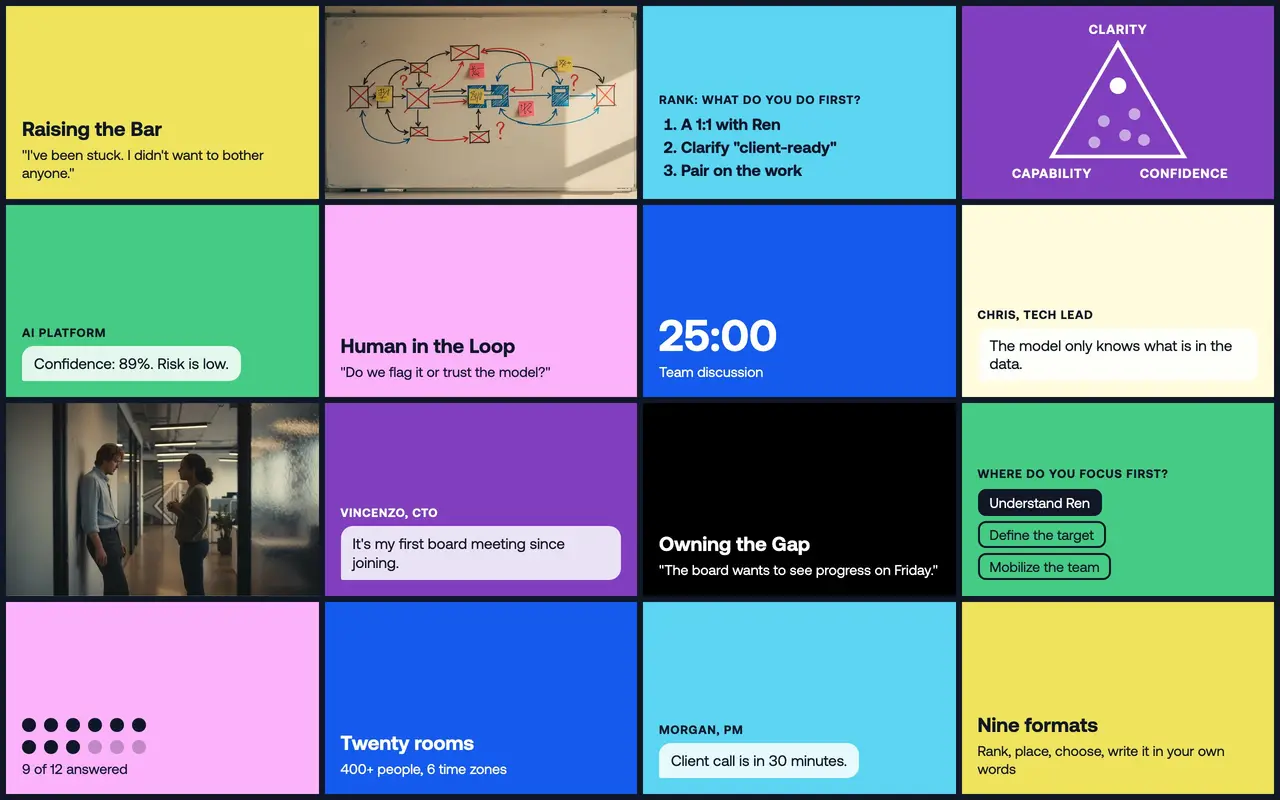
An AI platform scores its own recommendation at 89% confidence. The tech lead has checked the system connections by hand and thinks the model missed something. The client call's in thirty minutes.
Around the table, everyone commits to an answer privately, before anybody says a word out loud.
The game ends. Then what?

PS Starship had done its job. 1,300+ leaders across Publicis Sapient had been through the game and made their choices under pressure.
The team knew that was half of it. A game like that is where you find out what you'd do. It's not where you find out what your colleagues would've done, or why, or what any of it means for the account you're on next Monday.
Leadership Expectations don't change because 1,300 people enjoyed a spaceship. They change when somebody says out loud that they chose speed over consensus, and hears from six people who work with them what that choice looked like from the outside.
So the brief for part two was narrow and hard: sixty minutes, no theory, and every minute of it about their actual job.
Three drills, each one an uncomfortable Tuesday
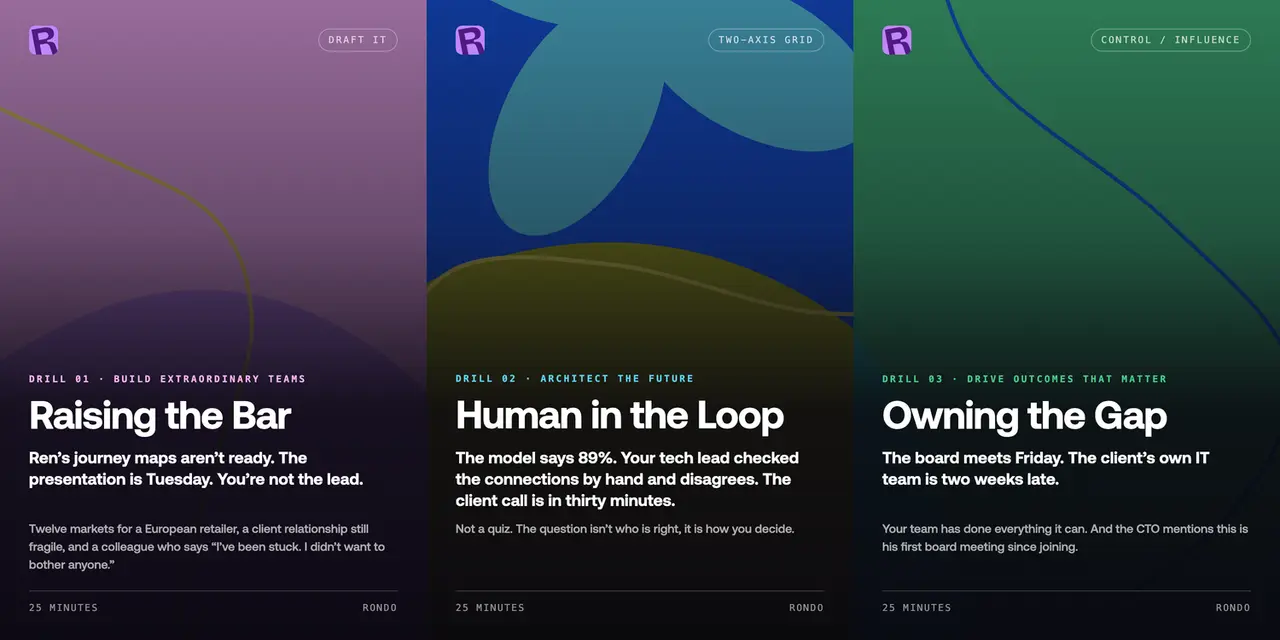
We wrote three original drills, one for each Leadership Expectation. None of them is about leadership in the abstract. Each is a situation somebody sitting there has already been in.
Raising the Bar. You're one week into a customer experience project for a retailer, experience maps due across twelve markets, the client relationship still fragile. A colleague's work isn't ready, the senior strategist has said so in the review and walked out, and the colleague catches you afterwards: "I've been stuck. I didn't want to bother anyone." Tuesday is the presentation. You're not the lead, but people listen when you speak.
Human in the Loop. The AI drill. A team three weeks into a platform modernization, an AI recommendation at high confidence, and a tech lead whose manual check disagrees with it. The drill is explicit that this isn't a quiz: the question isn't who's right, it's how you decide.
Owning the Gap. A board meeting on Friday, a client portal that can't be finished because the client's own IT team is two weeks late, and a CTO who mentions that it's his first board meeting since joining. Your team has done everything in its power. You're still stuck.
Much of it arrives the way it would arrive at work. Nobody sets the scene in a paragraph. The AI platform posts its confidence score into a team channel, the CTO sends a direct message the day before the board meets, and you read them the way you read the real ones.
The same flow, every drill
Every drill, in order
- Answer aloneEveryone commits privately, before anyone speaks
- Discuss as a teamTwenty-five minutes, with somebody taking notes. Nobody is graded
- DebriefThe host walks the rooms one at a time and shows what each decided
You answer alone first. Then the team discusses, twenty-five minutes, with somebody taking notes. Nobody's graded and no answer is marked correct: the instruction is to focus on the quality of the discussion.
Answering privately before the group speaks is what stops the most senior voice in the room from setting everyone else's answer, which is the main failure mode of every leadership workshop ever run off a slide.
Twenty rooms, one platform
We ran the workshop twenty times, for more than 400 people, across six time zones. Rondo is what made that the same workshop each time.
The three drills use nine different question formats between them, because the questions aren't all the same shape. Where the answer is a ranking, people rank. Where it's a trade-off between three things that can't all win, they place a marker inside a triangle and can see where their teammates put theirs. Where it's a call about a person, they write it in their own words.
A workshop that only knows how to ask multiple choice ends up bending every situation into multiple choice, which is how you get a leadership program that feels like a compliance module.
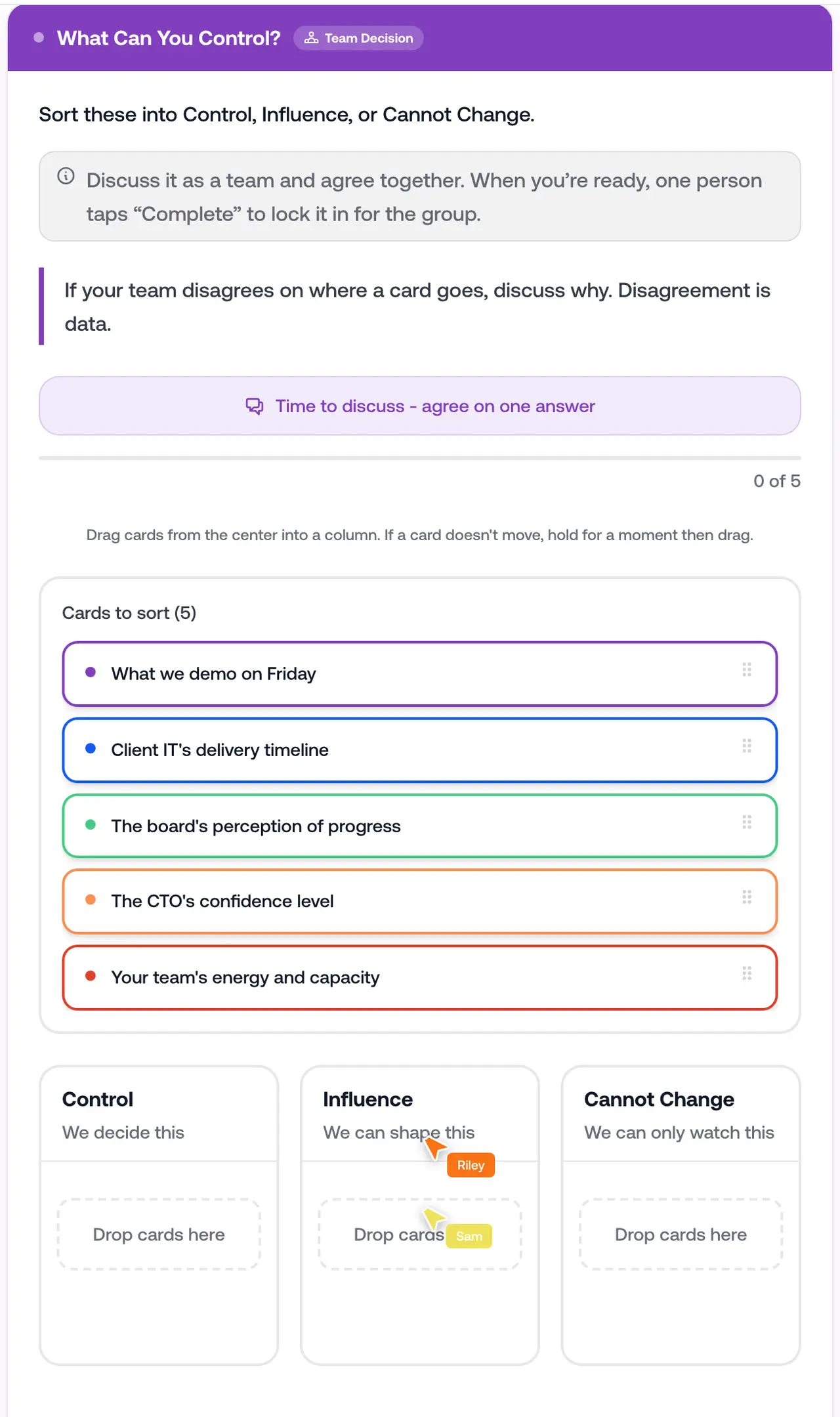
Participants never make an account. The host opens the session and sends a link to the chat, and people join on their laptops or phones. That sounds like a small thing until you're the twelfth person in a room of strangers in a hotel conference space, and the alternative is a password reset.
The host drives from a single screen showing what every room is doing, and can move the session on when the rooms are finished rather than when the clock says so. At the end, that same screen is the debrief: you walk the rooms one at a time and show what each of them decided.
Everything each room submitted is kept, so the answers can be read back afterwards instead of remembered from a photo of a whiteboard.
Then we taught their people to run it
On Rondo, we showed around 15 of Publicis Sapient's own hosts and learning operations people how to run it. They watched one drill from a participant's seat, then one of them ran the next one while we stayed out of it.
Twenty thousand people needs more hosts than we'll ever be, and a program that only works when its designers are running it is a series of events rather than something the firm owns.
They can now run the drills without us. Authoring new ones, publishing them and granting access still comes back to Wavetable, and closing that gap is the current work on Rondo.
What twenty rooms taught us
Running the same sixty minutes twenty times, in two hemispheres, changed how we schedule and how we open.
- Intact teams beat open sign-ups. The sessions that went best were whole teams whose lead had blocked the hour and told them to be there. People already knew each other, so the awkward first three minutes never happened and almost nobody dropped out. The same drill in a room of strangers gets less out of them.
- Less framing, more doing. We cut the setup deck down partway through the run and the feedback ratings went up. Twenty minutes of context before a drill feels responsible and buys you very little. The drill does the teaching.
- Group shape sets the clock, not the drill. Threes and fours need twenty-five minutes. Pairs are done in twenty. One of the three runs three to five minutes longer than the others because there are more decisions in it. We stopped scheduling by drill and started scheduling by room.
What came back session after session was that the drills matched people's day-to-day. When the practice mirrors the real job that closely, it is doing something a slide never could.
"Talking through the scenarios with others really gets me thinking. I wish we had more time."
The game this workshop follows: PS Starship →
Rolling out a leadership shift of your own? Book a 20-minute call →
More case studies
DIG
Shaping a culinary academy
Strategic planning and concept development for DIG Academy: defining audiences, curriculum architecture, and business model for a culinary education initiative rooted in farm-to-table values.
Publicis Sapient
A leadership rollout people could feel
Publicis Sapient was rolling new Leadership Expectations out to 20,000 people. We turned them into a starship they play in the browser, and team leads asked for more.
EY
A CX Program for global innovation teams, rated 8.86 out of 10
EY's global innovation teams knew CX theory and had nowhere to practice it under pressure. We built the practice, then moved it onto Rondo.