Host your own, on Rondo
Anyone on your team can run a session people remember.
The pitch next month, the reorg nobody's sure about, the new tool everyone has to use. Your team plays it through together first, and the host gets the situation, the clock and the first question to ask.
Get early accessSessions you can run ↓
One team, up to 12 people.
What your team gets.
- Run it whenever you need it, as often as you like.
- Everyone joins from a link, each on their own screen. No install, no app, no account.
- Every choice is recorded, so the conversation afterwards starts from what the team actually did.
- Where the team agreed and where it split. Rondo scores the play, never the person.
Your team hosts. Rondo does the rest.
Ready-made practice sessions your own team runs on Rondo, whenever something's coming up.
Your host
The host is someone on your team, and they get everything they need to run it.
Rondo
- Your host
They pick the session and open it.
- Rondo
Rondo brings the situation, the people in it, the clock and every choice, then shows the team its own decisions.
- Your host
The host leads the conversation afterwards.
Hosting your own is in early access, as a yearly license for each team.
What hosting looks like
The host's screen, through one round.
Open the room
The host opens the session and shares a code. Everyone joins from their own laptop.
Rondo runs the round
The situation, the clock and every answer. The host reads the room while the answers come in.
The host leads the talk
Everyone's answers turn over at once, and Rondo hands the host the first question to ask.
Sessions you can run.

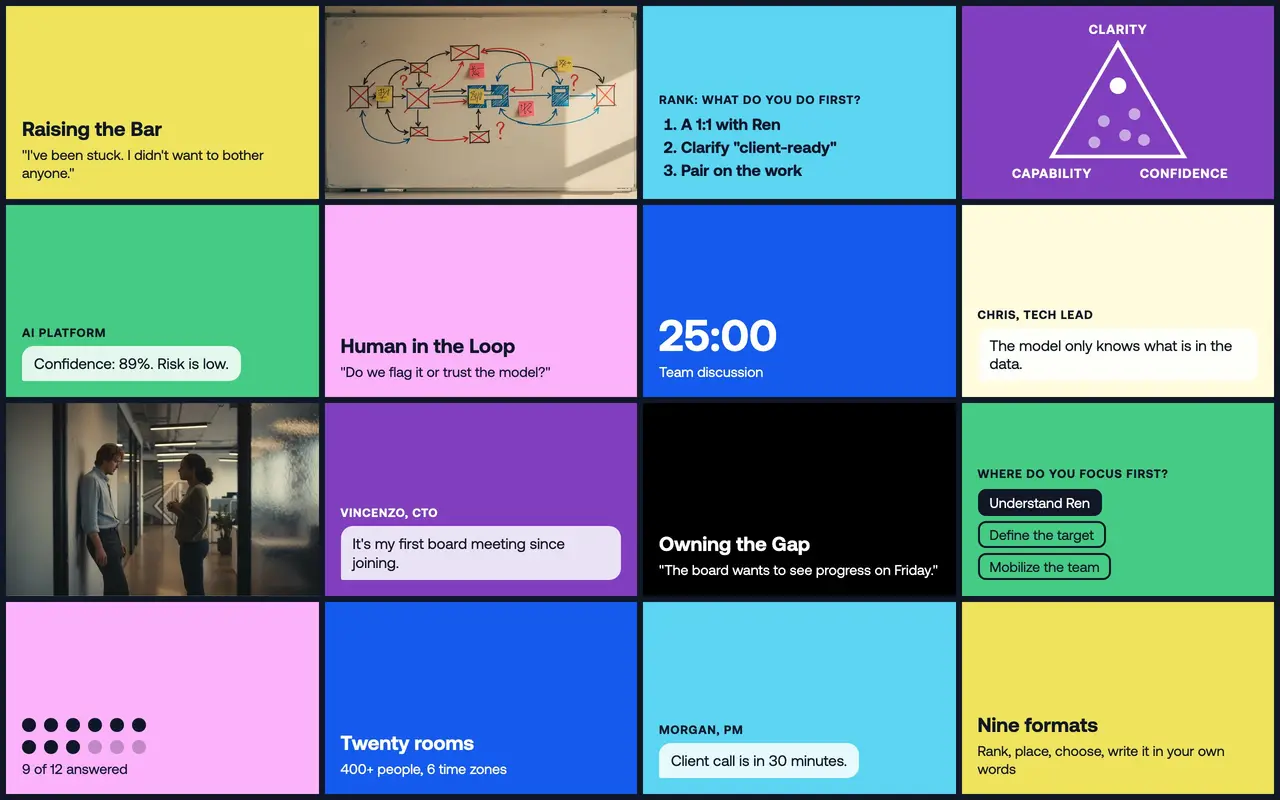
Twelve ready-made sessions in three themes, the same ones teams play in a Program. Pick the one closest to what your team faces next.

Pitches, renewals, reviews
The Room
The story you tell and the case you make, to the people who say yes or walk away.
Try the taster: Reframe the ObjectionYour read or the model's
Your instinct says one thing and the AI's analysis says another. Decide which one you take into the meeting.
The internal sell
Get your own leadership behind the idea before anyone outside sees it.
Telling the client you used AI
Part of the work was done with AI. How you tell the client, and when.
The account review
The meeting where the client decides whether you keep the work.
Reorgs, handovers, competing asks
The Impossible Middle
Three people want three different things, and they're all being reasonable.
Try the taster: The WeekCatch the confident mistake
Someone sure of themselves is about to get it wrong. Spot it, and say so.
Hand over or keep
Decide what to hand to someone else, or to a tool, and what to keep for yourself.
Six months from now, this failed
Imagine the plan has already failed, and work out why while there's still time to change it.
Saying no to good work
More good requests than the team can take on. Choose, and explain the no.
Service, complaints, the customer's view
The Other Side
What your service feels like to the person on the receiving end.
Try the taster: The Front DeskThe first ninety seconds
What a customer notices before anyone has said hello.
The safe version will get approved
The bold idea or the one that gets signed off. Make the case for the right one.
What they actually meant
Hear what the customer is asking for underneath what they said.
Where the customer gives up
Follow a customer from start to finish and find the step where it falls apart.
What's in every session.
The session itself, plus the bits either side of it.
Warm-up
A few quick pieces to play first, short enough for a train or bus ride, so the live time is for practicing, not catching up.
90-minute live session
Your team plays one situation through, live, with your host running it.
Post-session pack
Where the team split, what to try next, what to keep practicing.
The drill library
Short solo drills picked to match the session you ran, so your team keeps practicing between sessions.




Where Rondo already runs
Twenty Publicis Sapient rooms and the last two EY wavespace cohorts ran on Rondo, hosted by Wavetable. Hosting your own is new, and early-access teams are the first to do it.
Publicis Sapient
Turning one shared experience into twenty rooms of practice
PS Starship gave 1,300+ leaders a shared experience. Then they needed to talk about it, so we built three drills and ran them twenty times on Rondo.
EY
A CX Program for global innovation teams, rated 8.86 out of 10
EY's global innovation teams knew CX theory and had nowhere to practice it under pressure. We built the practice, then moved it onto Rondo.
Before you ask
What does it cost?
It's a yearly license for each team. Send the form and we'll come back with a price.
Can a session we've had count toward it?
Yes. Take a yearly license within 60 days of a session and the full session fee comes off it.
Our team is bigger than 12.
Tell us in the form. We'll suggest how to split people into teams.
Who can host?
Anyone on your team who's happy to lead a conversation. Rondo runs the situation, the clock and the choices, and hands the host the first question to ask.
How much does the host need to prepare?
They play the session through once on their own first. In early access, we walk them through it and are on hand for the first sessions.
How many sessions can we run?
As many as your team needs during the year.
Where does our data live?
In London, encrypted. Session responses are deleted 90 days after the session ends. More for your IT team
Get early access
Early access: the full session library for your team, and our help with the first sessions. In return we ask for your feedback, and a reference if it works. The price is set before you start and holds for the year.
We'll come back within two business days.