Family Reunion: Designing a 75-Minute Card Game for Family Office Executives
A custom card game for TBN Americas' Catalytic Capital Summit in Guatemala - where family office executives navigated fictional investment decisions through three competitive rounds, external judges, and real tensions about legacy versus innovation.
The Brief
TBN Americas asked us to design a series of workshop sessions for their first ever Catalytic Capital Summit - a gathering of family offices exploring impact investment. The audience: multi-generational wealth holders, advisors, and next-gen family members figuring out how to align capital with values.
We’d already created a pair of playable case studies for the event. But the other part of the brief was something different: a card game called "Family Reunion."
The goal wasn't icebreaking. It was to help participants understand how family values translate into investment decisions - through the lens of a fictional family navigating real tensions. Generational differences. Risk tolerance. Legacy versus innovation. The stuff that's hard to talk about directly but easier to explore through a story.
We had 75 minutes. A room full of Type-A executives. And we were asking them to play a card game.
Here are 10 elements of the build.
1. The Cold Open
The fastest way to kill a workshop game is to introduce it.
"We're going to do something a little different." "This might feel silly at first." "Trust the process."
The room's already deciding whether they're the type of person who plays games. Half of them have opted out before you've explained the rules.
When our slot arrived, we had a choice: explain what we were about to do, or just do it.
We didn't explain. We skipped the negotiation entirely. We said "something completely different"—then hit play.
A 60-second video. A fictional family business. Three generations, 100 years of history. By the time it ended, participants had already met the characters on the cards they were about to hold.
30 seconds in, I caught one participant's eye. She had this sparkle - childlike wonder. That's when I knew we had them.
2. World Building
The video wasn't decoration. It was the on-ramp.
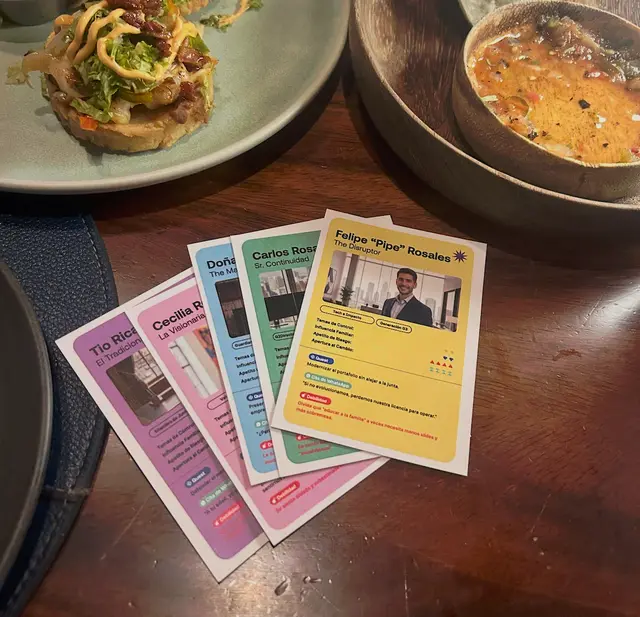
We introduced the Rosales family - a fictional dynasty with old money tensions and new money ambitions. The patriarch. The next generation. The young disruptors. Each character had values, quirks, blind spots.
When the manila envelopes opened a minute later, participants weren't learning a game. They were meeting people they'd already seen. The cards matched the characters. The world was already built.
A few people took photos of the screen and used their phones as reference throughout. We should have suggested it. Next time we will.
3. Familiar Strangeness
The narrator's voice in the video was deliberate. It sounded like those corporate legacy films from the eighties - patriarch gazing over the factory floor, stirring music, a tone of quiet gravitas.
You've heard it before but can't quite place it.
Same with the characters. You knew someone like each of them.
That half-recognition pulls people in without them knowing why.
We could have gone quirky. We could have gone slick. But this audience had grown up with that voice. It felt like family.
4. The Ritual
Physical materials matter.
Each round began with someone opening a manila envelope, pulling out the cards, spreading them on the table. It sounds small, but it created a rhythm - a ritual. Something to anticipate.
Digital would have been easier. But digital doesn't have the same weight. You don't gather around a screen the same way you gather around a table covered in cards.
We printed the cards on card stock - more hassle, more expensive, but they felt just like playing cards.
The tactile element wasn't nostalgia. It was design.
5. Rounds as Architecture
We broke the 75 minutes into three rounds, roughly 10 minutes each, plus setup and a debrief / reflectio.
Each round had a clear objective. Short enough to stay urgent. Long enough to get somewhere.
Rounds one and three had repetition - you were doing similar tasks multiple times, building speed, getting the hang of it. By the end of round one, people were racing. One participant scored 16 points- one every minute. He wanted every single one.
Round two was different. A palette cleanser. One task, more ambiguity, a moment to breathe. We'd built in some AI-generated content for that round, and we leaned into the looseness: "This stuff hallucinates, so there's no perfect answer." It gave people permission to play rather than optimise.
When we called time on each round, people looked up surprised. "What? We're done?" That's when you know the pacing worked.
6. Competition + Collaboration
These were competitive people. The kind who keep score even when there isn't one.
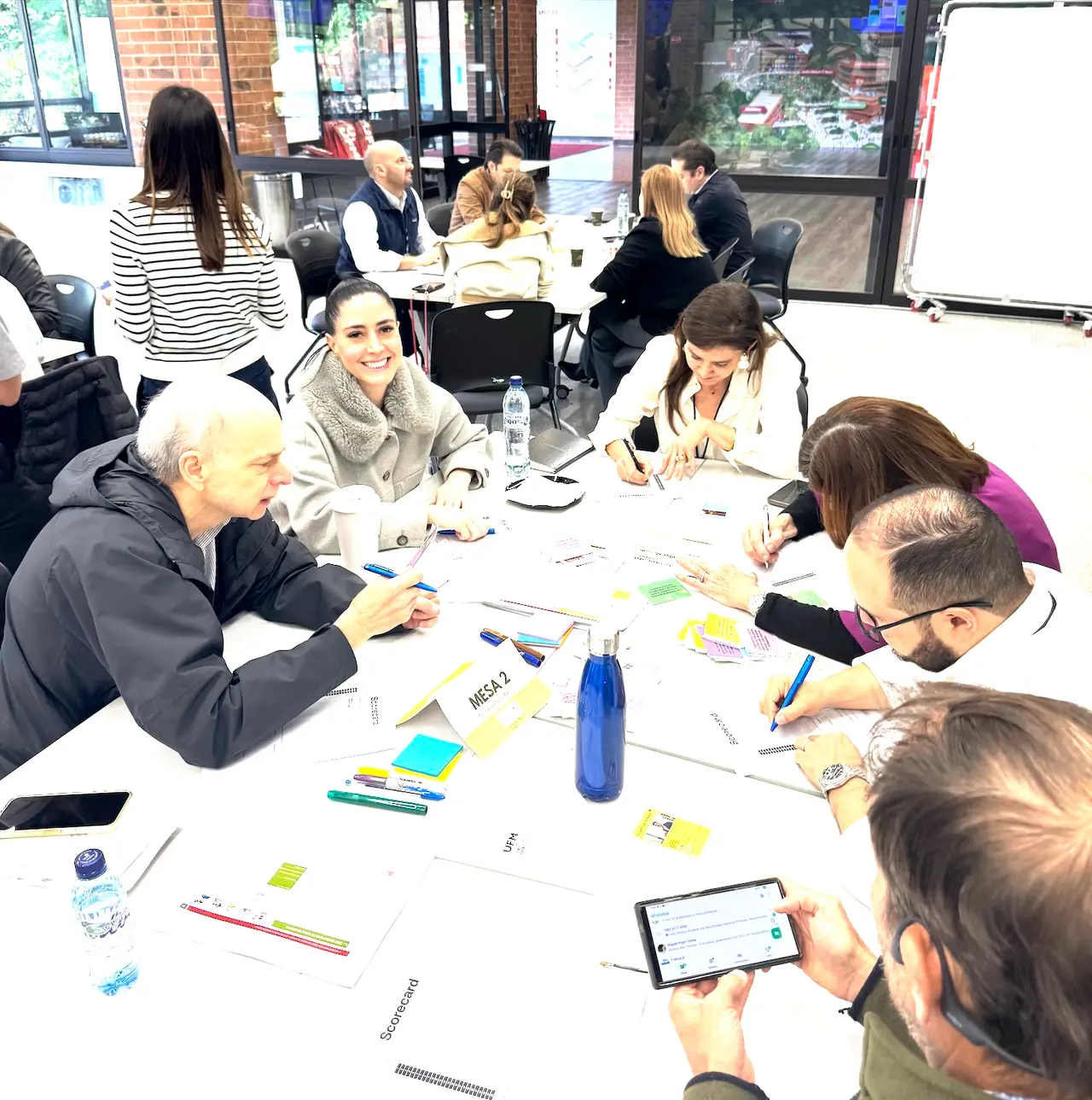
So we made it explicit. Scorecards on the tables. Points on the screen. No pretending this wasn't a game.
But pure competition can curdle a room. Someone's losing, they check out. Someone's dominating, the others stop trying.
So we designed for both. Team rounds where you had to collaborate to score. An individual round where you could shine on your own. You needed your team to win - but you could still stand out within it.
Multiple ways to win means more people stay in the hunt. The team can win. An individual can win. You're never fully out.
7. Don't Make People Feel Stupid
Eight minutes into the first ten-minute round, one team was still reading instructions. Other tables were racing through.
The easy move: hover, nudge, hint that time's almost up. The message they hear: you're doing it wrong.
That's the danger zone. When people feel slow or confused, the narrative flips fast. "This game is stupid." "Too rushed." "Who are these guys?" They're not behind—they're checked out.
So we called it out differently.
At the end of the round, we said: "Interesting - that table took a different approach. Read everything carefully first, then executed. That's a strategy."
They weren't slow. They were thorough.
Something shifted. By round three, that same team was the most organised in the room. They had a system for who would speak. They passed the mic around the table. Everyone contributed.
The goal isn't getting everyone to the same place at the same speed. It's making sure no one feels stupid for how they got there.
8. External Judges
For the final round, we brought in outside judges: Monica, program director at host university UFM, along with a couple of her team. They weren't facilitator - they were guests with credibility in the room. We introduced them as a hotshot (and hugely expensive) consultancy firm. This made several participants smirk - many of them had plenty of experience working with consultancies…
We gave our judges the cards, and they laid everything out on a table at the front. They took their role seriously. They deliberated. When they announced results, it wasn't a formality - it was a verdict.
The energy matched. Serious fun requires everyone to commit to the bit. If the judges had been casual, the room would have followed. Instead, Monica was winking with a smile the whole time - but she was in it.
You can't always get external judges. But if you can, it elevates everything.
9. Setting the Vibe
We didn't drop the game into the agenda cold. We linked it back:
"Yesterday you worked with Nacho on catalytic capital case study we'd designed. This morning Francesca talked about values. Now, you're going to put that thinking to work - through the lens of a fictional family facing real decisions."
That framing mattered. It wasn't a break from the serious stuff. It was an extension of it.
The game content backed that up. The questions were genuinely tough. Coming up with investment values for a fictional family requires you to understand what people care about, what tradeoffs they'd accept, how generations see things differently.
The fun was in the format and facilitation. The substance was real.
10. The Denzel Principle
The movie "Training Day" has plot holes you could drive a truck through. Wild coincidences. Logical leaps. But Denzel Washington's performance is so committed, so propulsive, that you stop noticing. The momentum carries you past the problems.
We had a version of this.
In round three, we'd written a few spicy curveball options - quirky choices to see if anyone would bite. We kept it to two. No one took them, which was fine. They stayed in the story.
If we'd added six, people would have started poking holes. "Wait, this doesn't make sense." "Why would anyone pick that?" The spell breaks. Suspended disbelief becomes just disbelief.
Momentum buys forgiveness, not immunity. A flawed design, you can perform through. A broken one, you can't - no matter how much energy you bring. The trick is knowing which one you've got.
Our goal isn't to be Denzel. It's to need him less.
The Payoff
How do you know it worked?
Not just that people played - but what they said at the end.
In the final round, teams had to present their investment strategies for the Rosales family based on a bunch of challenges and problems we’d presented to them.
We were bracing for surface-level answers. "We thought the brothers should get along." "Innovation is good."
Instead, we got this:
One team had drawn a political crisis wildcard. Their response: "This is expected. It's part of the cycle. You don't panic - you shift away from riskier positions and wait. If you're running a family office, you need to know how to hold steady."
Another team chose to double down on innovation during a downturn. Riskier. Counterintuitive. But they'd thought it through. They spent 2 minutes on the mic explaining exactly why.
By that point, they weren't playing a game. They were rehearsing decisions they might actually have to make - through a story that felt like theirs.
75 minutes. A room full of skeptics. A card game.
It worked.
You might like these posts
- How teams practice
Decision Rehearsal: the skill you can't lecture into people
Pilots get simulators. The rest of us get PowerPoints. How to build the expertise that only comes from rehearsing real decisions under pressure.
- How teams practice
The format is the lesson
Why training doesn't change behavior - and 30 interactive formats we built to fix it.